Lord of the Flies
Lord of the Flies is a chilling allegorical novel that strips away the veneer of civilisation to reveal the dark, primal instincts lurking within humanity. Studying this text rewards candidates who can perceptivey analyse Golding's use of symbolism, setting, and characterisation to construct a powerful argument about innate human evil.
Study Notes
Overview
William Golding's Lord of the Flies (1954) is a seminal post-war novel that functions as a dark allegory for human nature. Set against the backdrop of a nuclear war, it follows a group of British schoolboys stranded on a deserted island who rapidly descend from democratic order into brutal savagery. Examiners are looking for candidates who understand that the island is a microcosm of society, and that Golding's central thesis is that evil is not external, but innate to humanity. Top-band responses will consistently evaluate how Golding manipulates setting (pathetic fallacy), symbols (the conch, the glasses), and character archetypes to convey his pessimistic view of human morality.
Plot/Content Overview
- Arrival and Order: The boys crash-land. Ralph and Piggy find a conch shell, using it to summon the others. Ralph is elected chief over choir leader Jack. They establish rules and build a signal fire.
- The Descent Begins: Jack becomes obsessed with hunting pigs. The fire is allowed to go out just as a ship passes, causing the first major rift between Ralph and Jack.
- The Beast Emerges: A dead parachutist lands on the mountain, which the boys mistake for a terrifying 'Beast'. Fear takes hold of the group.
- The Schism: Jack breaks away to form his own savage tribe, offering a pig's head (the 'Lord of the Flies') as a sacrifice to the Beast.
- The Climax: Simon discovers the truth about the Beast but is murdered by the boys in a frenzied dance before he can tell them. Jack's tribe steals Piggy's glasses.
- The Collapse: Ralph and Piggy confront Jack. Roger murders Piggy with a boulder, destroying the conch. Jack's tribe hunts Ralph like an animal, setting the island on fire.
- Rescue: A naval officer arrives, drawn by the smoke. The boys weep, but the officer's presence is deeply ironic, representing the adult world's own violent warfare.
Themes
Theme 1: Civilisation vs. Savagery
This is the central conflict of the novel. Golding explores how the rules of civilised society are merely a fragile construct designed to suppress our innate, primal instincts. Ralph and Piggy represent order, democracy, and intellect, while Jack and Roger embody authoritarianism, violence, and base desires. The progression of the novel tracks the inevitable triumph of savagery over civilisation when societal constraints are removed.
Key Quotes:
- "Which is better - to have rules and agree, or to hunt and kill?" (Chapter 11) - Piggy's desperate final plea highlights the novel's central dichotomy.
- "Roger gathered a handful of stones and began to throw them. Yet there was a space round Henry, perhaps six yards in diameter, into which he dare not throw. Here, invisible yet strong, was the taboo of the old life." (Chapter 4) - Demonstrates how the conditioning of civilisation initially restrains violence, though this soon fades.
Theme 2: The Innate Evil of Humanity (The Beast)
Golding subverts the traditional adventure story by making the primary antagonist internal rather than external. The 'Beast' the boys fear is not a monster in the jungle, but the darkness within themselves. As their fear grows, so does their capacity for violence.
Key Quotes:
- "Maybe there is a beast... maybe it's only us." (Chapter 5) - Simon's intuitive, visionary understanding of the true nature of the threat.
- "Fancy thinking the Beast was something you could hunt and kill!... You knew, didn't you? I'm part of you?" (Chapter 8) - The hallucinatory dialogue between Simon and the Lord of the Flies makes Golding's allegorical meaning explicit.
Theme 3: Power and Leadership
Golding contrasts different models of political power. Ralph attempts to lead by consensus and rational planning, focusing on long-term rescue. Jack leads through fear, manipulation, and the promise of immediate gratification (meat). The novel reflects Golding's anxieties about the rise of fascism and totalitarianism in the 20th century.
Key Quotes:
- "The conch doesn't count on top of the mountain, so you shut up." (Chapter 2) - Jack's early dismissal of democratic rules foreshadows his later tyranny.
- "Power lay in the brown swell of his forearms: authority sat on his shoulder and chattered in his ear like an ape." (Chapter 9) - Describes Jack's transformation into an authoritarian dictator, reducing power to physical dominance and primitive instinct.
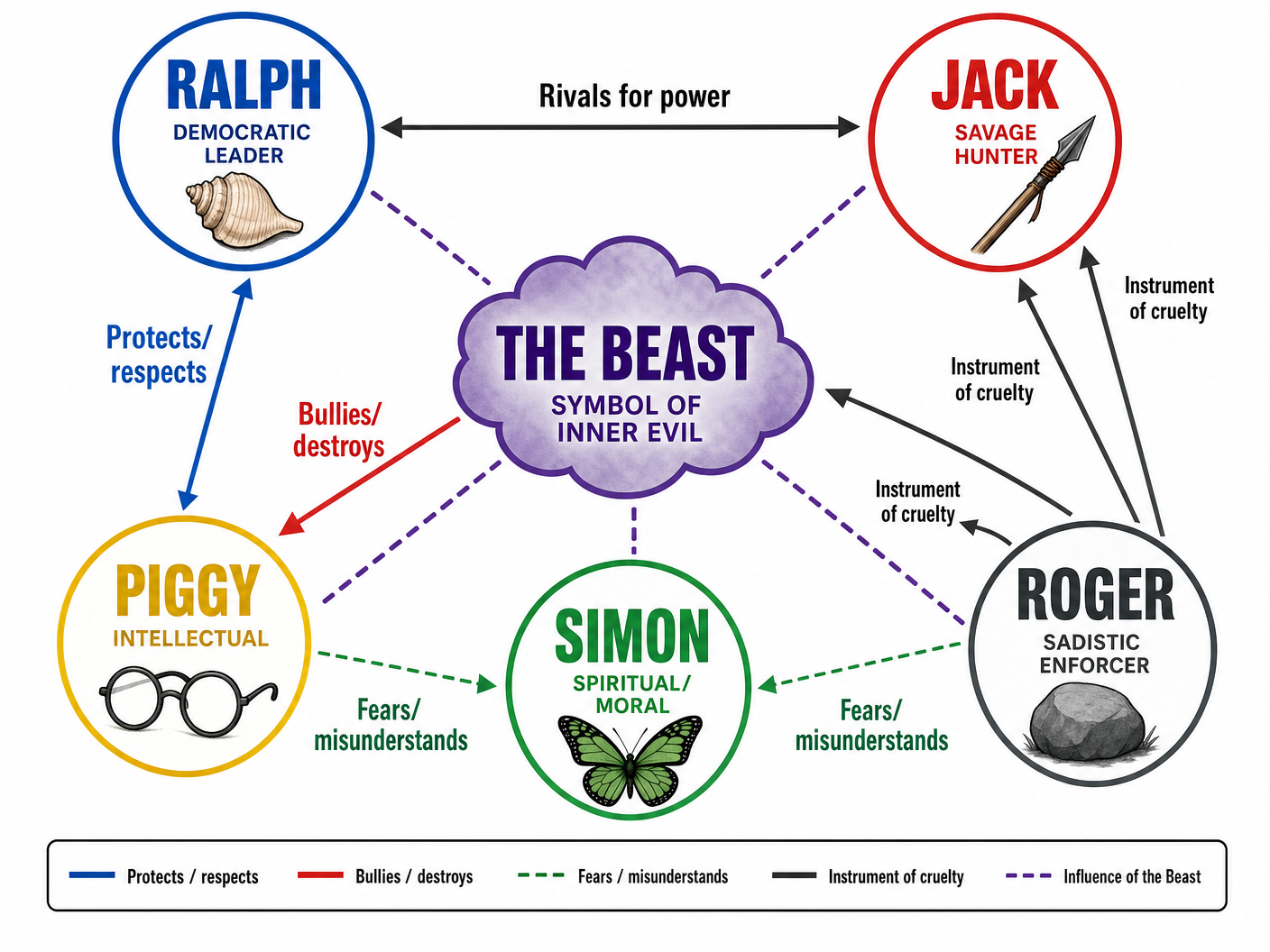
Character Analysis
Ralph
Role: The democratic leader, representing order, civilisation, and rational thought.
Key Traits: Attractive, charismatic, well-intentioned but flawed, increasingly reliant on Piggy's intellect.
Character Arc: Begins as an optimistic, confident boy who sees the island as a "good" place. Gradually loses his grip on authority and descends into despair as he witnesses the boys' savagery. By the end, he has lost his innocence entirely.
Essential Quotes:
- "Ralph wept for the end of innocence, the darkness of man's heart, and the fall through the air of the true, wise friend called Piggy." (Chapter 12)
- "There was a mildness about his mouth and eyes that proclaimed no devil." (Chapter 1)
Jack Merridew
Role: The antagonist, representing primal instinct, savagery, authoritarianism, and violence.
Key Traits: Arrogant, aggressive, manipulative, obsessed with hunting and power.
Character Arc: Starts as an arrogant choirboy who is initially constrained by societal rules (he hesitates to kill the first pig). He quickly sheds these constraints, using face paint to hide from his conscience, and becomes a brutal dictator who orchestrates murder.
Essential Quotes:
- "He began to dance and his laughter became a bloodthirsty snarling." (Chapter 4)
- "Jack, painted and garlanded, sat there like an idol." (Chapter 9)
Piggy
Role: The intellectual and voice of reason; the outsider.
Key Traits: Intelligent, physically vulnerable (asthma, poor eyesight), fiercely loyal to the rules of civilisation.
Character Arc: Remains steadfast in his belief in rules and adults throughout. His physical degradation (losing his glasses) mirrors the island's descent into chaos. His brutal murder marks the final death of reason.
Essential Quotes:
- "What are we? Humans? Or animals? Or savages?" (Chapter 5)
- "His head opened and stuff came out and turned red. Piggy's arms and legs twitched a bit, like a pig's after it has been killed." (Chapter 11)
Simon
Role: The visionary, the moral compass, a Christ-like figure.
Key Traits: Introverted, deeply connected to nature, possesses profound insight into human nature.
Character Arc: The only boy who recognises that the Beast is internal. He confronts the 'Lord of the Flies', discovers the truth about the dead parachutist, and is martyred when he tries to bring this truth to the others.
Essential Quotes:
- "Simon found for them the fruit they could not reach." (Chapter 3)
- "The water rose farther and dressed Simon's coarse hair with brightness. The line of his cheek silvered and the turn of his shoulder became sculptured marble." (Chapter 9)
Writer's Methods
Symbolism: Golding uses objects heavily to track the moral decay of the boys.
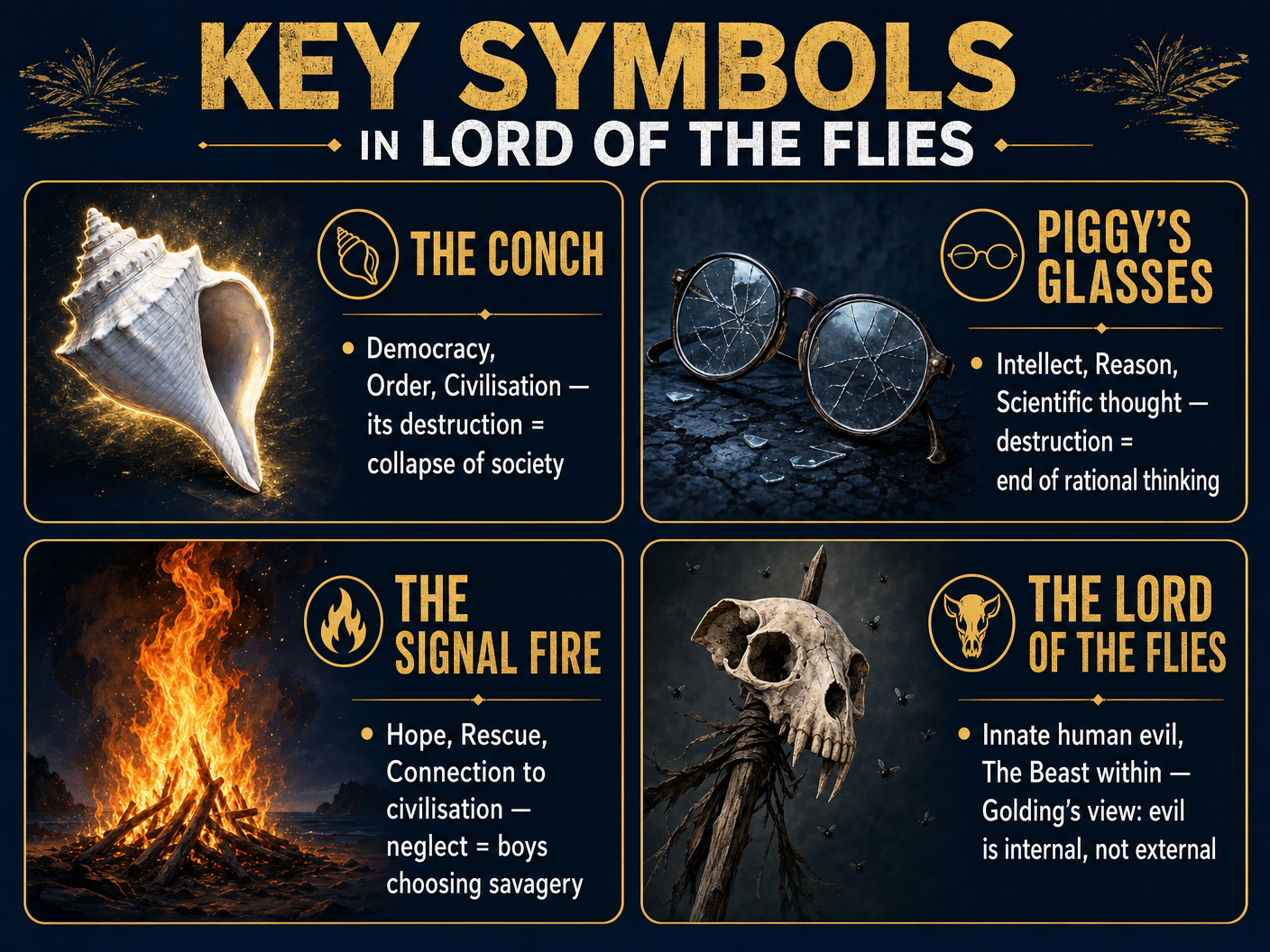
- The Conch: Represents democracy and order. Its fading colour and eventual shattering mirror the loss of civilisation.
- Piggy's Glasses: Represent scientific thought and clarity of vision. As they are broken and stolen, the boys lose their ability to see the truth.
- The Signal Fire: Represents hope and connection to the outside world.
- The Lord of the Flies: The pig's head on a stick is a physical manifestation of the boys' internal evil.
Setting and Pathetic Fallacy: The island is initially described as an Edenic paradise, but becomes increasingly hostile and threatening as the boys' behaviour worsens. The brutal murder of Simon is accompanied by a violent, chaotic thunderstorm, reflecting the unnatural horror of the act.
Narrative Perspective: Golding uses a third-person omniscient narrator, which allows him to provide an objective view of the boys' descent, while occasionally zooming in on specific characters' internal thoughts (particularly Simon and Ralph) to reveal deeper truths.
Context
Post-War Disillusionment: Written shortly after WWII, the novel reflects the trauma of the Holocaust, the atomic bomb, and the revelation of what civilised nations were capable of. Golding served in the Royal Navy and witnessed extreme violence, leading to his belief that "man produces evil as a bee produces honey."
Coral Island Parody: The novel is a direct subversion of R.M. Ballantyne's The Coral Island (1857), an optimistic Victorian novel where British boys easily overcome savages and maintain their moral superiority. Golding shatters this imperialist, romanticised view of British youth.
The Cold War: The novel was published during the Cold War, and the threat of nuclear annihilation hangs over the text (the boys are evacuated due to an atom bomb). The naval officer at the end is a stark reminder that the 'civilised' adult world is engaged in the same destructive behaviour as the boys.
Visual Resources
2 diagrams and illustrations
Interactive Diagrams
1 interactive diagram to visualise key concepts
Conceptual Flow Outline
The Descent into Savagery: Narrative Structure
Worked Examples
2 detailed examples with solutions and examiner commentary
Practice Questions
Test your understanding — click to reveal model answers
How does Golding present the theme of fear in Lord of the Flies?
Hint: Think about how fear is manipulated by Jack to gain power, and how Simon understands the true nature of what they should fear.
Explore the significance of the setting in Lord of the Flies.
Hint: The island changes from an Eden-like paradise to a hellish landscape. How does this mirror the boys' moral decay?
How does Golding present the relationship between Ralph and Jack?
Hint: Contrast their leadership styles: democracy vs. dictatorship.
Explore how Golding presents the loss of innocence in the novel.
Hint: Track the progression from well-behaved choirboys to painted savages.